
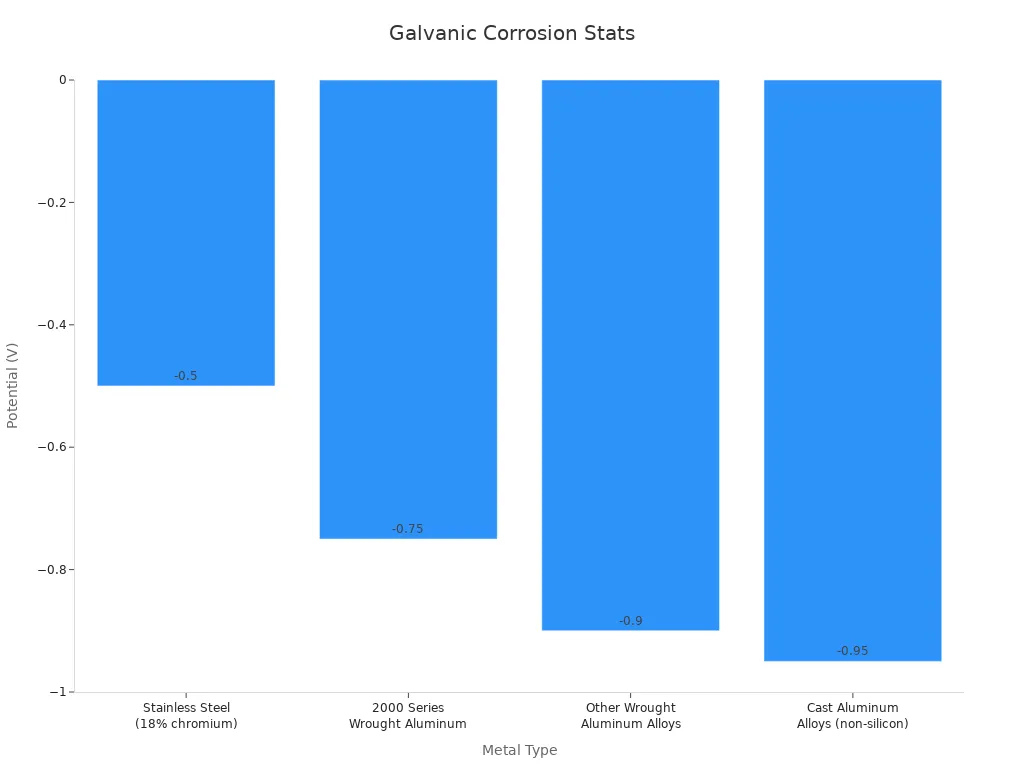
When you connect aluminum to stainless steel, you set up a classic case of galvanic corrosion. Aluminum sits lower on the galvanic series, so it acts as the anode and corrodes first. Stainless steel, which is more noble, becomes the cathode and stays protected. The electrochemical potential difference between these metals is large—about 1.16 volts. This big difference speeds up the corrosion of aluminum. You can see this effect in the table below:
| Metal | Electrochemical Potential (V) |
|---|---|
| Aluminum | -0.66 |
| Paslanmaz çelik | +0.50 |
Galvanic corrosion aluminum and stainless steel becomes a serious problem in many places where moisture acts as an electrolyte. You will notice much faster corrosion on aluminum parts, while stainless steel remains mostly unaffected. Galvanic corrosion can destroy aluminum quickly if you do not manage it.
Galvanic Corrosion Aluminum and Stainless Steel
How Galvanic Corrosion Works
When you join aluminum and stainless steel, you create a situation where galvanic corrosion can happen. This process starts when two dissimilar metals touch each other and an electrolyte, like water with salt, is present. You set up an electrochemical cell. Aluminum becomes the anode, and stainless steel becomes the cathode. The aluminum loses electrons and starts to dissolve, while the stainless steel stays protected.
You can see how scientists measure this process in the table below:
| Measurement Type | Description | Key Findings |
|---|---|---|
| Galvanic Current | Measures current flow between aluminum and stainless steel in saltwater | Current increases with more stainless steel area; confirms galvanic corrosion aluminum and stainless steel |
| Weight Loss | Tracks how much aluminum mass is lost when paired with stainless steel | Shows aluminum corrodes faster when connected to stainless steel |
| Open Circuit Potential | Measures voltage between metals not connected | Voltage alone does not predict corrosion rate; direct current measurement is better |
| Area Ratio Effects | Changes the size of aluminum and stainless steel in contact | More stainless steel area means faster aluminum corrosion |
| Electrochemical Methods | Uses special tools to measure galvanic current | Standard methods help compare galvanic corrosion aluminum and stainless steel |
Laboratory tests show that when you expose aluminum and stainless steel to salty air or water, galvanic corrosion speeds up. The aluminum near the joint corrodes first. Over time, you see more damage spreading from the connection point. In real-world tests, aluminum connected to stainless steel in a salt-spray chamber corrodes three times faster than aluminum alone after just 128 hours. If you leave the metals together for six months in acidic water, the aluminum can lose up to 3 mm of thickness.
Tip: If you increase the surface area of the stainless steel compared to the aluminum, the corrosion rate of the aluminum goes up even more. Always pay attention to the size of each metal in your design.
Galvanic corrosion aluminum and stainless steel happens because electrons flow from the aluminum (anode) to the stainless steel (cathode). The reactions look like this:
At the aluminum (anode):      Al → Al³⁺ + 3e⁻
At the stainless steel (cathode): ½O₂ + H₂O + 2e⁻ → 2OH⁻
The electrolyte, such as salty water, helps ions move between the metals. If you have crevices or joints, the corrosion can get worse because of differences in oxygen levels. Even the protective oxide layers on aluminum and stainless steel can affect how fast galvanic corrosion happens.
Why Aluminum Is More Vulnerable Than Stainless Steel
You might wonder why aluminum suffers more from galvanic corrosion than stainless steel. The answer lies in the galvanic series. Aluminum has a much more negative potential than stainless steel. This means aluminum always acts as the anode and corrodes first when you connect it to stainless steel.
- Aluminum’s amphoteric nature makes it corrode faster in both acidic and alkaline environments.
- The difference in galvanic potential between aluminum and stainless steel is large enough to cause rapid corrosion.
- Aluminum alloys can also suffer from intergranular corrosion, where the boundaries between grains in the metal become weak spots.
- Environmental factors like the type of electrolyte, pH, humidity, and temperature all make galvanic corrosion aluminum and stainless steel worse.
When you look at technical studies, you see that aluminum connected to stainless steel loses mass much faster than when it is alone. For example:
- The corrosion current density can increase up to 45 times when aluminum is joined with stainless steel.
- The corrosion rate can reach 2254 micrometers per year, which is much higher than for single metals.
- Mass loss rates show that aluminum degrades quickly in these pairs.
A detailed case study tested many aluminum alloys with different metals. It found that stainless steel always caused aluminum to corrode faster. The study also showed that not all metals protect aluminum. Some, like zinc, can even make corrosion worse in certain cases.
Note: Aluminum alloys have similar potentials, so they do not corrode each other much. But when you pair aluminum with stainless steel, the aluminum always becomes the sacrificial metal.
If you want to prevent galvanic corrosion aluminum and stainless steel, you need to understand why aluminum is more vulnerable. The large potential difference, the nature of aluminum, and the environment all play a role. By knowing this, you can make better choices in your projects and protect your materials from early failure.
The Galvanic Series and Electrochemical Potential
Understanding the Galvanic Series
You can think of the galvanic series as a ranking of metals based on how easily they give up electrons. This list helps you predict which metal will corrode first when two different metals touch each other in the presence of an electrolyte, like water. Aluminum sits near the bottom of the galvanic series, which means it has a high tendency to lose electrons and start corroding. Stainless steel, on the other hand, is much higher on the list and resists corrosion better.
When you connect aluminum and stainless steel, you create a situation where galvanic corrosion can happen quickly. The difference in their positions on the galvanic series sets up a strong driving force for corrosion. However, the actual rate of galvanic corrosion depends on more than just this difference. You also need to consider the environment, the surface area of each metal, and how the metals are joined.
- Galvanic corrosion depends on the specific combination of metals, the environment, and the way you assemble them.
- Aluminum forms a thin oxide layer that can slow down corrosion, but this layer can break down in harsh conditions.
- The rate of galvanic corrosion also depends on the individual corrosion behavior of each metal.
Electrochemical Potential Difference Explained
The electrochemical potential difference between two metals tells you how likely galvanic corrosion will occur. Recent research measured the potential difference between 316L stainless steel and an AlSi7Mg0.3 aluminum alloy at high temperatures. The results showed an average difference of about 0.93 volts. This large gap means that aluminum will corrode much faster when you connect it to stainless steel.
You should know that a bigger potential difference usually means a higher risk of galvanic corrosion. However, two metals with similar potentials can sometimes corrode even faster if both are active. The Gal/Corr ratio is a new way to compare galvanic corrosion rates to general corrosion rates. This helps you understand the real risk in your project.
Note: Always consider the environment, such as the presence of salt or moisture, because these factors can make galvanic corrosion worse. You should also pay attention to the surface area ratio between the metals.
Researchers use electrochemical tests, microstructural analysis, and visual inspections to study galvanic corrosion. These methods help you choose the right materials and design to reduce corrosion risks, especially in places like bridges or marine environments.
Conditions Required for Galvanic Corrosion
Dissimilar Metals in Contact
You need three main things for galvanic corrosion to happen. First, you must have two dissimilar metals touching each other. These metals have different corrosion potentials. When you connect them, one metal becomes the anode and the other becomes the cathode. The less noble metal, like aluminum, acts as the anode and starts to corrode. The more noble metal, such as stainless steel, acts as the cathode and stays protected. This process is also called dissimilar metal corrosion.
Scientists have tested different metal pairs in labs to see how this works. They used metals like copper, iron, and zinc in acidic solutions. The table below shows what they found:
| Aspect | Evidence Summary |
|---|---|
| Experimental Setup | Metals like Cu, Fe, Zn tested together in chloride solution. |
| Key Findings | Galvanic corrosion starts when metals with different potentials touch. The area ratio and type of metals change how fast corrosion happens. |
| Environmental Factors | pH, oxygen, and distance between metals affect corrosion severity. |
You can see that not just the type of metals, but also their size and how close they are, make a big difference. If you use a small piece of aluminum with a large piece of stainless steel, the aluminum will corrode even faster.
Tip: Always check which metals you are connecting. Using dissimilar metals without protection can lead to fast corrosion and early failure.
Electrical Connection and Electrolyte Presence
For galvanic corrosion to occur, you also need an electrical path and an electrolyte. The metals must be electrically connected so electrons can flow from the anode to the cathode. Water, especially if it contains salt, acts as the electrolyte. The electrolyte lets ions move between the metals, completing the circuit.
Researchers have measured how different electrolytes affect corrosion rates. When you increase the salt concentration in water, the corrosion of aluminum speeds up. For example, in tests with sodium chloride, the depth of corrosion pits in aluminum grew from about 1.5 micrometers at low salt to over 31 micrometers at high salt. The table below shows some measurements:
| Measurement | Description |
|---|---|
| Galvanic coupling current | Measures how much current flows between metals in salty water. |
| Electrolyte concentration | Higher salt means more corrosion. |
| Electrolyte film thickness | Thicker films can increase corrosion rates. |
You should remember that both the electrical connection and the presence of an electrolyte are required. If you remove either one, galvanic corrosion will not happen. This is why you often see more corrosion in wet or salty environments, especially when dissimilar metals are joined.
Note: Dissimilar metal corrosion can be severe in places like coastal areas or where water collects on metal joints. Always try to keep connections dry or use barriers to stop the flow of electricity and ions.
Real-World Impact of Galvanic Corrosion
Common Examples in Industry and Daily Life
You see galvanic corrosion in many places around you. When you connect aluminum and stainless steel, the risk of corrosion increases, especially in wet or salty environments. Here are some common examples of galvanic corrosion:
- In the oil and gas industry, pipelines and offshore rigs often use both aluminum and stainless steel. Water, salt, and even certain gases make corrosion worse. The National Association of Corrosion Engineers reports that corrosion costs this industry up to $2.2 billion each year.
- Air to water heat exchangers in data centers use copper and aluminum together. Galvanic corrosion can cause leaks, blockages, and even system failures. If you live near the ocean or in a city with acid rain, the risk goes up.
- In chilled water systems, you may see pipe damage and clogged pumps from corrosion particles. This can happen in just a few years if you do not monitor water quality or material choices.
- Everyday items like boats, bicycles, and outdoor furniture can show damage from galvanic corrosion when aluminum parts touch stainless steel in the rain.
Safety risks from corrosion include leaks, system downtime, and even major failures. You need to check for corrosion and use the right materials to keep things safe.
Effects on Material Strength and Longevity
Galvanic corrosion aluminum and stainless steel can weaken structures over time. Long-term studies show that aluminum alloys lose strength as corrosion eats away at the metal. For example, research on 6060 aluminum alloys in seawater shows deep pits and cracks after years of exposure. These changes make the metal less able to hold weight or resist pressure.
You may notice that corrosion does not always happen at the same rate. Sometimes, it starts slow and then speeds up. This pattern can make it hard to predict when a part will fail. Over decades, the effects of galvanic corrosion can shorten the life of bridges, buildings, and machines that use aluminum and stainless steel together.
If you want your projects to last, you must understand how galvanic corrosion affects material strength. Regular checks and smart design choices help you avoid costly repairs and keep your equipment working longer.
Factors That Accelerate Galvanic Corrosion
Surface Area Ratios of Aluminum and Stainless Steel
The surface area ratio between aluminum and stainless steel plays a big role in galvanic corrosion. When you connect a small piece of aluminum to a large piece of stainless steel, the aluminum corrodes much faster. Research on dissimilar metal welds shows that a lower anode-to-cathode surface area ratio increases the corrosion rate of the anodic metal. The larger stainless steel area provides more sites for cathodic reactions. This raises the current density on the aluminum, making it corrode quickly. You should always try to keep the aluminum area as large as possible compared to the stainless steel. This design choice helps slow down galvanic corrosion and protects your materials.
Environmental Influences Like Moisture and Salt
Moisture and salt in the environment can speed up galvanic corrosion. Studies show that corrosion rates can change by up to 40 times depending on climate and exposure to salt or pollutants. When water or salt collects on metal joints, it acts as an electrolyte. This allows ions to move between the metals and makes corrosion worse. Machine learning models and experiments both show that the conductivity of the electrolyte, which depends on moisture and salt, is the most important factor in how fast corrosion happens. If you work in marine or coastal areas, you need to pay extra attention to these risks. Even rain or humidity can create the right conditions for galvanic corrosion.
Tip: Regularly clean and dry metal joints to reduce the risk of corrosion from moisture and salt.
Design and Installation Pitfalls
Many design and installation mistakes can make galvanic corrosion worse. You might see problems when aluminum and stainless steel touch without insulation, especially if water or salt is present. Some common pitfalls include:
- Using metals with large nobility differences, which increases corrosion risk.
- Allowing direct contact between aluminum and stainless steel without inert washers or coatings.
- Creating unfavorable surface area ratios, where aluminum is much smaller than stainless steel.
- Failing to use dielectric materials like nylon washers or sleeves to break electrical contact.
- Letting metal burs or scratches cut through protective coatings.
- Using fasteners that do not match the nobility of the main metals.
You should always check your designs for these issues. Good practices include choosing metals with small nobility differences, applying protective coatings, and using sacrificial anodes. Regular inspection and maintenance help catch problems early and keep galvanic corrosion under control.
Prevention Strategies: Sacrificial Anodes and More
When you want to prevent galvanic corrosion between aluminum and stainless steel, you have several proven strategies. Each method helps you protect your materials, save money, and extend the life of your equipment. Let’s look at the most effective ways to stop corrosion before it starts.
Material Selection and Compatibility
Choosing the right materials is your first line of defense. You should always check if the metals you plan to use are compatible. Some metals, like stainless steel and certain aluminum alloys, resist corrosion better because of their chemical makeup and microstructure. When you select materials, think about the environment, such as humidity, temperature, and the presence of salt or other corrosive agents.
Here are some important factors to consider:
- Pick metals with similar electrochemical potentials to reduce the risk of galvanic corrosion.
- Use alloys that form protective oxide layers, like stainless steel with chromium or special magnesium alloys.
- Consider the mechanical stresses your materials will face, such as bending or vibration, since these can make corrosion worse.
Tip: Always balance corrosion resistance with cost and strength. Sometimes, a slightly more expensive alloy can save you money in the long run by lasting longer.
Case studies show that microstructural design and alloying can improve corrosion resistance. For example, researchers found that adding calcium to magnesium alloys refines the grain structure and makes the metal more resistant to corrosion. Books and technical data also highlight how the right material choice can prevent galvanic corrosion in harsh environments.
You can see the main factors in this list:
- Environmental conditions: Moisture, temperature, and chemicals in the air or water.
- Material composition: Alloying elements like chromium or calcium.
- Mechanical stresses: How much the metal bends, stretches, or vibrates.
| Study/Source | Key Finding |
|---|---|
| Jian et al. (2013) | Microstructural design improves corrosion resistance in magnesium alloys. |
| Deng et al. (2021) | Alloying with calcium creates “stainless magnesium” with better corrosion resistance. |
| Ghali (2010) | Technical data supports choosing compatible aluminum and magnesium alloys. |
When you understand these factors, you can select materials that work well together and prevent galvanic corrosion from the start.
Using Barriers and Protective Coatings
Barriers and coatings act like raincoats for your metals. They keep water, salt, and other corrosive agents away from the metal surface. You can use paint, powder coatings, or special tapes to separate aluminum from stainless steel. Even a thin layer can make a big difference.
Many experiments show that coatings with zinc flakes provide strong protection. These coatings dissolve slowly and protect the metal underneath, even if the coating gets scratched. Outdoor tests prove that zinc flake coatings prevent red rust for months, while regular epoxy coatings do not. The type of binder in the coating also matters. Inorganic binders let water pass through and help the zinc flakes connect, which boosts protection.
- Scratched coatings with zinc flakes keep protecting the metal, while passive coatings fail when damaged.
- Higher salt levels in the environment increase the need for strong coatings.
- Magnesium and aluminum oxides in coatings slow down corrosion, making them useful for certain climates.
Note: Always check the environment where you will use the metal. Some coatings work better in dry places, while others are best for wet or salty areas.
You should also use physical barriers, like nylon washers or plastic sleeves, to stop direct contact between metals. This simple step can prevent galvanic corrosion at joints and fasteners.
Installing Sacrificial Anodes
Sacrificial anodes offer another powerful way to prevent galvanic corrosion. You attach a more reactive metal, such as aluminum or zinc, to your structure. This metal becomes the anode and corrodes first, protecting the more valuable parts. You can find sacrificial anodes in boats, pipelines, and even bridges.
Researchers have tested many types of sacrificial anodes. Aluminum-based anodes with small amounts of silicon or tin work well. These anodes change the way corrosion products form and give strong cathodic protection to steel. Salt spray and immersion tests show that alloys like Al-2Si and Al-1Sn keep steel free from red rust for weeks. However, the area ratio between the anode and the metal you want to protect matters. A larger anode area gives better protection.
Electrochemical tests and microscopy reveal that some alloys, like Al-Sn, break down in a network pattern. This helps the anode stay in contact with the steel and keeps protecting it. You should know that anodes with high self-corrosion rates get used up faster, so you may need to replace them more often.
Recent research also uses electrochemical impedance spectroscopy to study how sacrificial anodes work in different solutions. These studies help you pick the best anode for your needs. The market for sacrificial anodes keeps growing because they are easy to install, cost-effective, and last a long time.
| Benefit | Description |
|---|---|
| Service life extension | Galvanic anodes can protect structures for up to 14 years, much longer than regular repairs. |
| Cost savings | Using sacrificial anodes can cut life cycle costs by up to 90% over 30 years. |
| Environmental impact | Sacrificial anodes reduce the need for repairs, saving energy and lowering carbon footprint. |
Callout: Always check the spacing and size of your sacrificial anodes. Closer spacing and the right current output give better protection and make your system last longer.
By using these prevention strategies—smart material selection, strong barriers and coatings, and well-designed sacrificial anodes—you can prevent galvanic corrosion, protect your investments, and keep your structures safe for years.
Regular Inspection and Maintenance
You play a key role in keeping your equipment safe from galvanic corrosion. Regular inspection and maintenance help you spot early signs of corrosion before they turn into bigger problems. When you check your aluminum and stainless steel connections often, you can take action to prevent galvanic corrosion and save money on repairs.
Many industries use advanced tools to monitor corrosion. Galvanic monitoring measures the electrochemical potential between metals. This method gives you real-time data about corrosion rates. You do not need to calibrate these sensors often, so they work well for field maintenance. Ships, offshore platforms, and pipelines use this technology because seawater acts as an electrolyte and speeds up galvanic corrosion.
You can also use visual inspections to find early signs of damage. Today, some companies use drones with artificial intelligence to scan large structures. These drones spot rust, pitting, and cracks that you might miss with the naked eye. If you want to check the thickness of metal parts, ultrasonic testing works well. This nondestructive method lets you measure how much metal has corroded without cutting or damaging the part.
Here are some common inspection and maintenance steps:
- Use galvanic monitoring sensors to track corrosion rates between aluminum and stainless steel.
- Perform visual inspections, sometimes with drones, to look for rust, pits, or cracks.
- Measure metal thickness with ultrasonic tools to find hidden corrosion.
- Keep detailed records of all inspections and repairs.
Regular checks help you catch corrosion early. You can then apply protective coatings, install sacrificial anodes, or repair small sections before the damage spreads.
Real-world maintenance records show that early detection saves money and keeps your equipment strong. The Royal Australian Navy and Saudi Aramco both report better asset integrity and lower costs when they use these inspection methods. New technologies, like Voliro’s drone system, make it easier to inspect hard-to-reach places and collect real-time data.
If you want to prevent galvanic corrosion, you must make inspection and maintenance a regular habit. Early action lets you use barriers, coatings, or sacrificial anodes before corrosion causes serious harm. By staying alert and using the right tools, you protect your investment and extend the life of your aluminum and stainless steel parts.
You now know that aluminum corrodes faster when you connect it to stainless steel. This happens because of their positions on the galvanic series and the electrochemical reaction between them. Research shows that corrosion depends on many factors, such as water chemistry, metal surface area, and flow speed. Corrosion can last for decades and cause serious damage if you do not act. You can prevent corrosion by choosing the right materials, using barriers, installing sacrificial anodes, and checking your equipment often. Take steps today to protect your aluminum parts and make them last longer.
SSS
What is galvanic corrosion and why does it happen between aluminum and stainless steel?
You see galvanic corrosion when you join dissimilar metals like aluminum and stainless steel. The metals touch and an electrolyte, such as water, completes the circuit. Aluminum acts as the anode and corrodes faster, while stainless steel stays protected.
How can you prevent galvanic corrosion in your projects?
You can prevent galvanic corrosion by using barriers, coatings, or sacrificial anodes. Choose compatible metals and keep connections dry. Regular inspection helps you spot early signs of damage from galvanic corrosion before it spreads.
What are some common examples of galvanic corrosion in daily life?
You find common examples of galvanic corrosion on boats, outdoor furniture, and pipelines. When you connect dissimilar metals in wet or salty places, corrosion often appears quickly. This damage can weaken structures and cause leaks.
Why do sacrificial anodes help protect against dissimilar metal corrosion?
Sacrificial anodes protect your equipment by corroding first. You attach a more reactive metal, like zinc or aluminum, to your structure. The sacrificial metal takes the damage from galvanic corrosion, so your main parts last longer.