
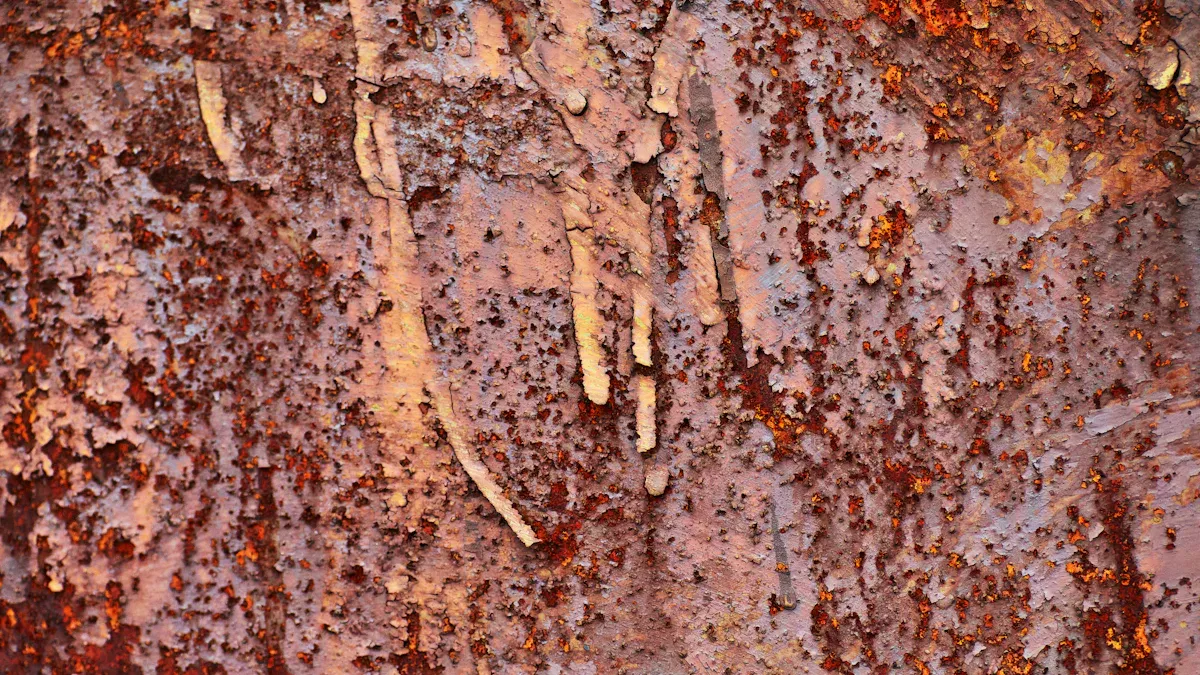
When you place aluminum and steel together, you create a risk of aluminum steel galvanic corrosion. This process starts when both metals touch and water or saltwater acts as an electrolyte. You will notice that aluminum, as the anode, loses material faster than steel.
| Parameter / Condition | Experimental Data |
|---|---|
| Thickness loss after 6 months (pH 4) | Up to 3 mm |
| Thickness loss after 6 months (pH 7) | Up to 0.22 mm |
| Thickness loss after 6 months (pH 9.2) | Up to 0.2 mm |
- Saltwater, humidity, and pH changes increase corrosion rates in aluminum steel galvanic corrosion.
- Studies show that aluminum always acts as the anode, confirming its faster corrosion in these pairs.
What Is Galvanic Corrosion?
Galvanic corrosion happens when you connect two different metals, like aluminum and stainless steel, in the presence of an electrolyte such as water. This process starts because each metal has a different electrochemical potential. When you join these metals, one acts as the anode and the other as the cathode. The anode loses material faster, which leads to corrosion. You often see this problem in places where moisture is present, such as bridges, ships, and water pipes.
How Galvanic Corrosion Occurs
You can understand galvanic corrosion by looking at what happens when you connect dissimilar metals. The less noble metal, such as aluminum, becomes the anode and corrodes more quickly. The more noble metal, like steel or stainless steel, acts as the cathode and stays protected. For galvanic corrosion to occur, you need four things:
- An anode (less noble metal, such as aluminum)
- A cathode (more noble metal, such as steel)
- An electrolyte (water, saltwater, or even humid air)
- A direct electrical connection between the metals
When these conditions exist, electrons flow from the anode to the cathode through the metal. At the same time, ions move through the electrolyte. This movement causes the anode to lose metal and form corrosion products. You can see this process in many real-world situations:
- Aluminum shielding in buried telephone cables often corrodes when touching steel.
- Steel pipes with brass or aluminum fittings show visible corrosion at the joints.
- Ship hulls made of steel with aluminum or stainless steel parts experience rapid corrosion in saltwater.
- The Statue of Liberty suffered from galvanic corrosion between its copper skin and iron support structure.
- Aircraft parts, such as horizontal stabilizers, use aluminum and stainless steel, which can corrode if not protected.
Researchers have studied galvanic corrosion in many ways. For example, mineralogical analysis of old water pipes shows different corrosion patterns depending on which metal acts as the anode. Laboratory experiments confirm that the less noble metal, like lead or aluminum, corrodes faster when paired with a more noble metal. Microelectrode measurements reveal that the pH drops near the anode and rises near the cathode, which matches the electrochemical theory.
You can see how many technical resources support these findings in the table below:
| Author(s) | Year | Source/Type | Description |
|---|---|---|---|
| Frankel, G.S. | 2012 | Journal AWWA (peer-reviewed journal) | Letter discussing galvanic corrosion, providing expert commentary on the topic. |
| Frankel, G.S. & Landolt, D. | 2007 | Encyclopedia of Electrochemistry (technical reference) | Detailed kinetics of electrolytic corrosion reactions including galvanic corrosion mechanisms. |
| Giammar, D.E., Welter, G.J., Cantor, A. | 2012 | Water Research Foundation report (technical report) | Literature review on galvanic corrosion projects, summarizing prior research findings. |
| Hack, H.P. & Wheatfall, W.L. | 1995 | Naval Surface Warfare Center report (technical report) | Evaluation of galvanic corrosion in copper-nickel piping systems, providing applied data. |
| Davis, J.R. | 2000 | ASM International (technical book) | Comprehensive corrosion basics including galvanic corrosion principles and examples. |
| Dudi, A. | 2004 | Master’s thesis (academic research) | Study on lead corrosion and galvanic corrosion in drinking water systems. |
| Edwards, M.A. | 2012 | Journal AWWA (peer-reviewed journal) | Discussion on water quality effects on galvanic coupling, relevant to corrosion behavior. |
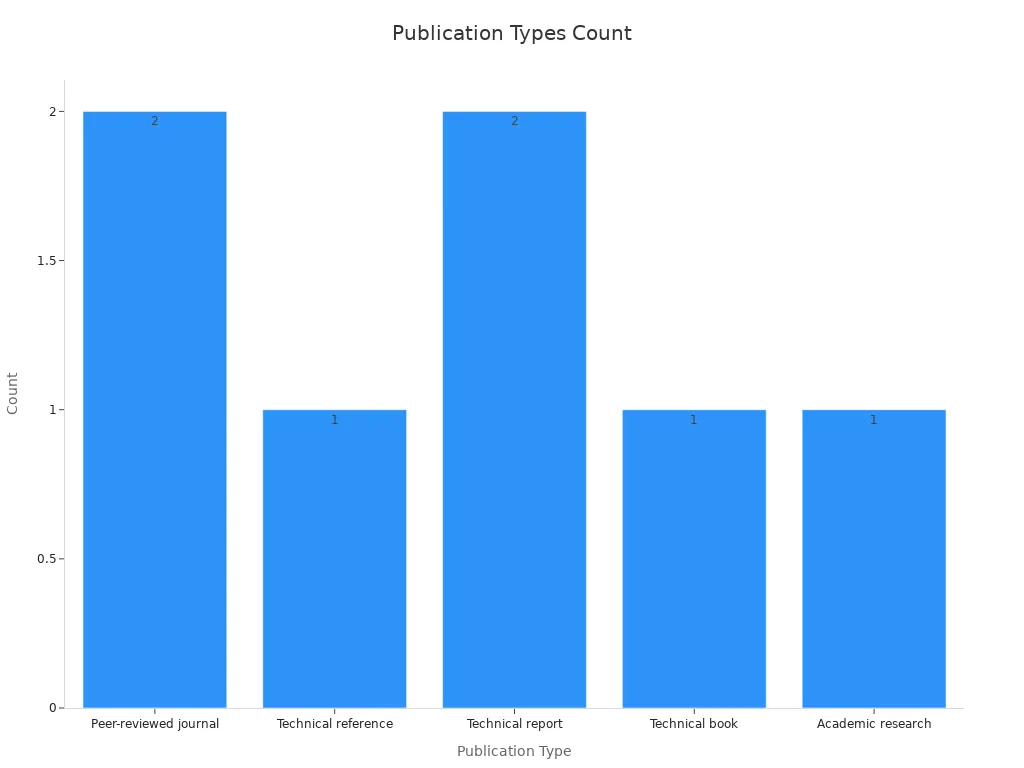
You can also see the types of publications that support the definition of galvanic corrosion:
Why Aluminum Steel Galvanic Corrosion Is a Concern
Aluminum steel galvanic corrosion creates serious problems in many industries. When you use aluminum and stainless steel together, the aluminum corrodes much faster. This rapid loss of material can weaken structures, cause leaks, and lead to expensive repairs. You might see this in bridges, ships, airplanes, and even in your home plumbing.
Several studies highlight the dangers of aluminum steel galvanic corrosion:
- Reviews show that aluminum alloys are very susceptible to localized corrosion when paired with steel.
- Microstructural features in aluminum can make corrosion start even faster.
- Research points out that corrosion products can change the way bolts and joints behave, making them more likely to fail.
- Regulatory standards from groups like ANSI and ASTM stress the need to prevent galvanic corrosion in construction and infrastructure.
You can learn from real-world examples:
- The USS Arizona Memorial had aluminum parts that corroded quickly when in contact with steel in saltwater, which threatened the structure.
- The San Francisco-Oakland Bay Bridge needed costly repairs because of severe corrosion between carbon steel and stainless steel.
- Experts recommend using protective coatings, insulation, and careful material selection to avoid these problems.
Tip: Always check for the causes of corrosion before you combine dissimilar metals in a project. Good design and regular maintenance can help you avoid costly damage.
Aluminum steel galvanic corrosion does not just affect the appearance of metal parts. It can change how strong they are and how long they last. Up to 30% of infrastructure maintenance costs come from corrosion control, so preventing galvanic corrosion saves money and keeps people safe.
The Science of Aluminum Corrosion with Steel
Anode and Cathode Roles in Aluminum Steel Galvanic Corrosion
When you connect aluminum and steel, you create a galvanic couple. In this pair, aluminum always acts as the anode, and steel becomes the cathode. This happens because aluminum is less noble than steel. You can see this ranking in the galvanic series, which lists metals by their tendency to corrode. The less noble metal, with a lower electrode potential, loses electrons and corrodes faster.
You might notice that the difference in nobility between aluminum and steel increases the corrosion rate of aluminum. If you attach a small piece of aluminum to a large piece of steel, the aluminum will corrode even faster. This is because the large cathode area (steel) draws more electrons from the small anode area (aluminum), speeding up the process.
You can find many real-world examples of this effect:
- Aluminum fasteners on steel structures often corrode quickly.
- Aluminum foil touching steel pans will show signs of corrosion.
- Small aluminum parts attached to larger steel surfaces degrade faster.
Note: You can slow down galvanic corrosion by using similar metals, adding insulation, or applying protective coatings.
Technical studies confirm these roles:
- Metals are ranked by nobility in the galvanic series. More noble metals act as cathodes, less noble metals as anodes.
- The greater the difference in nobility, the higher the corrosion rate of the anodic metal.
- Aluminum is less noble than steel, so it acts as the anode and corrodes first.
- The surface area ratio matters. A small anodic area with a large cathodic area increases the corrosion rate.
- Practical examples include aluminum fasteners corroding on steel due to their anodic nature and smaller size.
- Metallurgical data and real-world tests confirm these principles.
The Role of Electrolytes in Aluminum Corrosion
You need an electrolyte for galvanic corrosion to happen. An electrolyte is a liquid that helps ions move between the two metals. Water, especially saltwater, is a common electrolyte. When you expose aluminum and steel to moisture, the electrolyte lets electrons and ions flow, starting the corrosion process.
Scientists use special tests to study how electrolytes affect aluminum corrosion:
- Chronoamperometry experiments measure how fast aluminum corrodes in different electrolytes at a set temperature.
- Electrochemical quartz crystal microbalance studies show how corrosion products build up or wash away.
- Changing the salt type and concentration in the electrolyte changes how fast aluminum corrodes. For example, aggressive salts like sodium chloride make corrosion worse.
- High salt concentration and thick electrolytes can sometimes slow corrosion by trapping corrosion products on the aluminum surface.
- Water’s high dielectric constant helps ions move, which speeds up corrosion.
- The formation of a solid electrolyte interphase (SEI) layer can protect or expose aluminum, depending on the chemicals in the electrolyte.
You can see that the type of electrolyte, its concentration, and even the temperature all change how quickly aluminum corrosion happens. If you keep aluminum and steel dry, you can prevent most galvanic corrosion.
Why Aluminum Acts as the Anode
You might wonder why aluminum always acts as the anode when paired with steel. The answer comes from electrochemical measurements. Scientists measure the electrode potentials of metals in solutions like diluted seawater. Aluminum has a more negative electrode potential than steel. This means aluminum gives up electrons more easily, making it the anode.
Researchers use galvanic current measurements and polarization curves to prove this. When you connect aluminum and steel, the current flows from aluminum to steel. The area ratio between the cathode and anode also affects how fast aluminum corrodes. If you increase the cathode area, you increase the corrosion rate of aluminum.
Polarization curves show that aluminum forms a thin, protective layer called a passive film. However, in the presence of an electrolyte, this layer can break down, and aluminum corrosion speeds up. These scientific tests confirm that aluminum always acts as the anode in aluminum steel galvanic corrosion, and it corrodes first.
You can see these findings in laboratory experiments:
- Systematic tests measured galvanic current and weight loss in aluminum alloys joined with 4130 steel in saltwater.
- The experiments checked how solution composition, area ratio, and cathode material changed corrosion rates.
- Results showed that 4130 steel caused moderate corrosion of aluminum alloys.
- Galvanic current increased with cathode area, supporting the mixed potential theory.
- Electrochemical methods gave clear, quantitative evidence of aluminum-steel galvanic interaction.
Other studies tested aluminum alloys and 4130 steel in different waters:
- Galvanic current and weight loss were measured in 3.5% NaCl, tap water, and distilled water.
- The type of cathode changed how much aluminum corroded.
- Coupling 4130 steel with aluminum alloys led to cathodic effects that influenced corrosion rates.
- Researchers evaluated the susceptibility of different anode materials and the effects of the cathode.
A third study looked at aluminum and stainless steel in salt-spray conditions:
- The team prepared the metals to meet aerospace standards.
- They checked the grain size and particle distribution, which affect corrosion.
- A thin film of electrolyte formed on the metals under controlled humidity and salt.
- After 128 hours, coupled specimens had three times more corrosion than single-metal specimens.
- The corrosion zones grew wider over time, showing how galvanic corrosion spreads.
🧪 Scientists use these experiments to understand and predict how aluminum corrosion happens when you pair it with steel. You can use this knowledge to choose better materials and prevent damage.
Factors Affecting Aluminum Steel Galvanic Corrosion
Environmental Conditions (Water, Salt, Humidity)
You will notice that environmental conditions play a big role in galvanic corrosion between aluminum and steel. Water, salt, and humidity all speed up the process. When you expose aluminum and stainless steel to salty air or water, the risk of corrosion increases. Field studies on bridges show that chloride, found in salt, makes galvanic corrosion much worse. Researchers tested 11 bridge alloys in salt-spray chambers and found that corrosion rates rise sharply in chloride-rich environments. The results also show that each metal reacts differently depending on the environment. For example, corrosion happens faster in salty or humid places than in dry, clean air.
- Field and lab tests use electrochemical techniques and visual inspections.
- Chloride presence increases galvanic corrosion rates between aluminum and steel.
- Corrosion behavior depends on both the metals and the specific environment.
- Material combinations and assembly methods affect how much corrosion occurs.
- Experts recommend more testing of bridge alloys under different environmental exposures.
Simulation models also show that salt raises humidity and moisture levels, which speeds up corrosion. Statistical studies link ions like chloride and sodium in water to higher metal degradation. These findings help you understand why water chemistry and air quality matter for galvanic corrosion.
Surface Area Ratios and Material Pairing
The size and pairing of metals change how fast galvanic corrosion happens. If you attach a small piece of aluminum to a large piece of steel, the aluminum will corrode much faster. Engineering studies compare different setups and show that dissimilar material pairings, like aluminum and stainless steel, increase corrosion rates. The table below shows how surface area and material choice affect corrosion:
| Parameter | Configuration Type | Material Pairing | Key Findings |
|---|---|---|---|
| Corrosion Current Density (i_corr) | Single Stent | Bare-Metal Stent (BMS) | Baseline: 11.75 μA/cm² |
| Corrosion Current Density (i_corr) | Stent-on-Plug | BMS on Vascular Plug (VP) | Increased ~45 times to 522.3 μA/cm², indicating severe galvanic corrosion |
| Corrosion Rate (CR) | Stent-on-Plug | BMS on VP | Up to 2254 μm/year, significantly higher than individual components |
| Mass Loss Rate (MR) | Stent-on-Plug | BMS on VP | 42.22 mg/cm²/year, indicating accelerated material degradation |
| Polarization Resistance (RP) | Individual vs Combined | BMS vs BMS-on-VP | Significant decrease in RP in combined (galvanic) configurations, indicating increased corrosion |
| Surface Coating Effect | DLC Coating | DLC-coated Stents | DLC forms protective barrier, increasing impedance and RP, reducing corrosion current and ion release |
You can see that using similar materials and balancing surface areas helps reduce galvanic corrosion. Protective coatings also lower corrosion rates.
Quality of Protective Coatings and Material Selection
You can slow galvanic corrosion by choosing the right materials and using high-quality coatings. Research shows that the distance between metals and their electrochemical potential difference affect corrosion speed. If you increase the distance between the aluminum and steel, you reduce the galvanic current and slow corrosion. Protective coatings work by forming barriers that block moisture and ions. Metallic coatings like zinc or cadmium offer sacrificial protection, while ceramic and polymer coatings add chemical stability and abrasion resistance. Tests in salt spray chambers prove that good coatings and careful material selection protect against galvanic corrosion. You should always check the coating type and quality before using aluminum and stainless steel together.
Tip: Use coatings and select materials wisely to extend the life of your structures and prevent costly repairs from galvanic corrosion.
Preventing Aluminum Steel Galvanic Corrosion
Insulation and Physical Barriers
You can prevent galvanic corrosion by using insulation and physical barriers between aluminum and steel. When you separate the metals, you stop the flow of electrons that causes corrosion. Technical studies show that aluminum foil works well as a barrier. It blocks chloride-containing fluids from reaching the metal surfaces and acts as a cathodic protector. This method helps protect aluminium from corrosion, especially in high-temperature settings.
You should also choose the right insulation materials. Cellular glass does not absorb water, so it keeps moisture away from the metals. Avoid materials like glass fiber unless you add extra protection. The table below shows key points for using insulation and barriers:
| Aspect | Key Points on Prevention of Aluminum-Steel Galvanic Corrosion |
|---|---|
| Insulation Materials | Use nonabsorbent types like cellular glass |
| Aluminum Foil Wrap | Blocks chloride solutions and protects metal surfaces |
| Jackets/Barriers | Use plastic or synthetic-rubber jackets to keep water out |
| Moisture Control | Ventilate insulation to avoid trapped moisture |
| Inspection & Maintenance | Check barriers regularly and repair as needed |
Regular inspection and maintenance help you catch problems early and reduce the impact of corrosion.
Protective Coatings and Paints
Applying protective coatings and paints is another way to protect aluminium from corrosion. You can use epoxy or epoxy-phenolic coatings on clean metal surfaces. These coatings resist water and chemicals, which helps prevent or delay corrosion. Long-term field studies show that even if coatings crack from sunlight, they can still stop corrosion underneath. For example, tests on EonCoat panels found no rust, even when the surface looked damaged.
You can also use nondestructive tests, like black light checks, to spot coating wear before corrosion starts. This lets you plan repairs based on the real condition of the coating, not just a set schedule. These methods help you maintain strong protection and keep costs down.
Material Selection and Design Strategies
You can reduce galvanic corrosion by choosing the right materials and using smart design strategies. Research suggests you should select materials with similar corrosion potentials. This limits the chance for galvanic corrosion to start. New materials like high-entropy alloys, ceramic coatings, and polymer composites offer better resistance. You can also use nanotechnology to make coatings that last longer.
Design optimization helps you avoid risky metal pairings. Computational modeling lets you predict how materials will behave together. You can use surface treatments like electroplating or vapor deposition to add extra protection. Monitoring tools, such as electrochemical impedance spectroscopy, help you detect corrosion early. By combining these strategies, you can protect structures and reduce the impact of corrosion over time.
Environmental Controls and Maintenance
You can control the environment around aluminum and steel to reduce corrosion. Good environmental controls help you keep moisture, salt, and chemicals away from metal surfaces. When you manage these factors, you slow down the corrosion process and protect your equipment.
Many industries use maintenance programs that focus on corrosion prevention. For example, a refinery-wide Risk-Based Inspection (RBI) program targets corrosion in equipment and piping. This program includes regular inspections, maintenance tasks, and upgrades to materials. You can see the benefits of such programs in the following ways:
- Inspection and maintenance tasks focus on both fixed and rotating equipment, as well as piping circuits.
- Environmental controls include steps to stop water carryover, which can cause faster corrosion.
- Chemical programs help you monitor and control corrosion in real time.
- Improved recordkeeping lets you track corrosion problems and plan repairs.
- Upgrading materials and following best practices for furnace maintenance also reduce corrosion risks.
A table shows how these actions help you save money and improve safety:
| Action | Benefit |
|---|---|
| Regular inspections | Early detection of corrosion |
| Water carryover mitigation | Slower corrosion rates |
| Chemical monitoring | Better corrosion control |
| Recordkeeping improvements | Easier tracking and planning |
| Material upgrades | Longer equipment life |
The RBI program found that investing about $2 million in inspection and maintenance could reduce economic risk by $82.6 million. This shows that environmental controls and good maintenance pay off.
🛠️ Tip: Set up a regular inspection schedule and keep good records. You can catch corrosion early and avoid costly repairs.
You should always check for leaks, remove standing water, and keep surfaces clean. When you combine these steps with smart material choices and coatings, you create a strong defense against corrosion.
You can see that aluminum steel galvanic corrosion leads to fast aluminum damage when the metals touch. By learning how corrosion works and what affects it, you make better choices for your projects. Prevention strategies show real results:
- Museums lower corrosion rates by controlling humidity.
- Outdoor vehicles and ships last longer with new coatings.
- Smart prevention saves up to 30% of yearly corrosion costs.
When you use the right inhibitors, corrosion rates can drop by over 99%. Prevention keeps your structures safe and strong for years.
FAQ
What is the main cause of aluminum steel galvanic corrosion?
You create galvanic corrosion when you connect aluminum and steel with water or saltwater present. The metals touch, and an electric current flows. Aluminum loses metal faster because it acts as the anode.
How can you tell if galvanic corrosion is happening?
You may see white or gray powder on aluminum. Pitting or holes can appear. Steel usually stays shiny. If you notice fast damage on aluminum near steel, galvanic corrosion is likely.
Can you stop galvanic corrosion completely?
You cannot always stop it completely, but you can slow it down. Use coatings, barriers, or choose metals with similar corrosion resistance. Regular checks and maintenance help prevent severe damage.
Does saltwater make corrosion worse?
Yes, saltwater speeds up galvanic corrosion. Salt acts as a strong electrolyte. You should keep aluminum and steel dry or use protective coatings in salty environments.
What materials work best as barriers between aluminum and steel?
You can use plastic, rubber, or special paints as barriers. These materials block moisture and stop the electric current. Good barriers help protect aluminum from fast corrosion.