
When you choose galvanized steel pipe dimensions, you make decisions that impact how long your system will last. The outside diameter, wall thickness, and other measurement terms help you match the right pipe to your needs. Studies show that environmental factors like soil pH and moisture can change how a galvanized steel pipe performs. For example, in recommended conditions, one type of pipe can last about 40 years. Knowing the correct pipe size and diameter helps you avoid early corrosion and get the best service life.
Essential Galvanized Steel Pipe Dimension Terms
Diámetro exterior (DE)
You need to understand the outside diameter (OD) when you select galvanized steel pipes. OD measures the distance across the pipe from one outer edge to the other. This measurement is important because it affects how pipes fit together and how strong they are. If you choose the wrong OD, your pipe may not connect properly or handle the pressure you need.
Tip: Always check the OD before you buy or install a pipe. This helps you avoid leaks and weak spots in your system.
OD plays a big role in several ways:
- It determines if your pipe will fit with connectors and fittings.
- It affects how much pressure the pipe can handle.
- It helps keep your system safe and reliable.
Manufacturers use standards like ASTM, ISO, ANSI, and ASME to make sure OD measurements are accurate. These standards set rules for how pipes are made and measured. They also help you match pipes from different brands or countries.
You will see OD listed in both metric and imperial units. This makes it easier to use pipes in projects around the world. OD also connects closely to wall thickness and pressure ratings, so you get the right performance for your needs.
Inside Diameter (ID)
Inside diameter (ID) tells you how wide the open space is inside the pipe. This space is where water, gas, or other materials flow. If you want to know how much a pipe can carry, you look at the ID.
The ID is always smaller than the OD because the pipe wall takes up space. When you pick a pipe, you need to think about both the OD and the ID. The ID changes if you choose a pipe with a thicker or thinner wall, even if the OD stays the same.
A larger ID means more flow, but it can also mean less strength if the wall is too thin. You should balance flow needs with safety and pressure requirements. Always check the ID when you plan your system, so you get the right amount of flow without risking leaks or bursts.
Nominal Pipe Size (NPS)
Nominal pipe size (NPS) is a standard way to talk about pipe size. NPS does not always match the actual diameter of the pipe. For pipes from NPS 1/8 to 12, the NPS number is not the same as the outside diameter. For example, an NPS 12 pipe has an OD of 12.75 inches. When you look at NPS 14 and above, the NPS number matches the OD. So, an NPS 14 pipe has an OD of 14 inches.
NPS started as a way to describe the inside diameter for standard wall pipes. Over time, as wall thickness options changed, NPS became a label that relates to both OD and ID, but not exactly to either one. The OD stays the same for a given NPS, even if you pick a different wall thickness. This makes it easy to use the same fittings and connectors for pipes with the same NPS.
You will find that wall thickness changes with the schedule number, like Sch 40 or Sch 80. Thicker walls mean higher pressure ratings. Standards like ASME B36.10 and B36.19 give you tables that show how NPS, OD, wall thickness, and schedule all connect. These tables help you choose the right pipe for your project.
Note: Using NPS helps you match pipes and fittings, even if the actual diameter is different. This system makes it easier to design and build safe, reliable piping systems.
Here is a simple table to show how NPS, OD, and ID can differ:
| NPS (inches) | OD (inches) | Typical ID (Sch 40, inches) |
|---|---|---|
| 2 | 2.375 | 2.067 |
| 4 | 4.500 | 4.026 |
| 8 | 8.625 | 7.981 |
| 12 | 12.750 | 12.000 |
You can see that the NPS is not always the same as the OD or ID. This is why you need to check all the dimensions before you choose a pipe.
Schedule (SCH)
When you look at galvanized steel pipe dimensions, you will see the word “Schedule” or “SCH” next to the pipe size. Schedule tells you how thick the wall of the pipe is. You might see numbers like SCH 40, SCH 80, or SCH 160. These numbers do not show the actual wall thickness in millimeters or inches. Instead, they are codes that help you compare different pipes.
A higher schedule number means the pipe has a thicker wall. For example, SCH 80 pipe has a thicker wall than SCH 40 pipe, even if both have the same outside diameter. Thicker walls help the pipe handle more pressure. You need to choose the right schedule based on how much pressure your system will have.
Tip: Always check the schedule when you select a pipe. This helps you make sure the pipe can handle the job.
You will find that schedule numbers are set by standards like ASME B36.10. These standards help you match pipes and fittings from different manufacturers. When you pick a schedule, you also affect the inside diameter of the pipe. A thicker wall means a smaller inside space for water or gas to flow.
Espesor de pared
Wall thickness is one of the most important parts of galvanized steel pipe dimensions. It tells you how strong and safe your pipe will be. You measure wall thickness as the distance between the outside and inside surfaces of the pipe. If you want your pipe to last longer and resist damage, you need to pay close attention to wall thickness.
You can measure wall thickness using special tools. Here is how you do it:
- Use calipers to measure the outer diameter by placing the jaws on opposite sides and reading the scale.
- Use micrometers to measure wall thickness by positioning the pipe between the spindle and anvil and reading the precise measurement.
- Take several measurements around the pipe to check for thickness changes and calculate an average.
- Make sure your measuring tools are calibrated and in good condition for accurate results.
- Record and check your measurements to help with quality control and design.
Wall thickness matters for many reasons:
- The environment where you use the pipe, such as pressure, temperature, and wear, affects the needed thickness.
- The type of material, like low carbon steel or alloy steel, changes the required thickness.
- Larger pipes usually need thicker walls to handle more pressure and outside forces.
- National and industry standards set common thickness ranges, usually from 0.8 to 2.5 mm, but you can adjust this for your needs.
- The right thickness helps prevent corrosion, supports pressure, keeps your system safe, and makes the pipe last longer.
- Hot-dip and cold-dip galvanized pipes have different thickness needs, so always check the type.
If you choose the wrong thickness, your pipe might fail early or not meet safety rules. Always follow guidelines and measure carefully.
Pipe Length Types
You will find several types of pipe length when you buy galvanized steel pipes. The length you choose affects how easy your project will be and how many joints you need to make. Most pipes come in standard lengths, but you can also order custom lengths for special jobs.
Here are the main types of pipe length:
- Random Length (RL): Pipes in this group have a length that falls within a set range, usually 5 to 7 meters. You use random length pipes when exact length is not important.
- Fixed Length (FL): These pipes have a set length, such as exactly 6 meters. Fixed length pipes help you plan your project and reduce waste.
- Double Random Length (DRL): These pipes are longer, often between 10.5 and 13 meters. You use double random length pipes for big projects where you want fewer joints.
- Custom Length: You can order pipes cut to any length you need. Custom length pipes help you fit special spaces or designs.
Note: Always check the length before you order. This helps you avoid extra cutting and saves time during installation.
The length of the pipe also affects how you transport and store it. Longer pipes may need special trucks or storage racks. If you use the right length, you can make your system stronger and reduce leaks.
When you understand schedule, wall thickness, and length, you can choose the best galvanized steel pipe dimensions for your project. This helps you build a safe, strong, and long-lasting system.
Threaded and Coupled (T&C)
When you see the term “Threaded and Coupled” or T&C, it means the pipe ends have threads, and a coupling connects them. This system lets you join pipes without welding. You twist the threaded ends into a coupling, which holds them tight. T&C pipes are common in plumbing, construction, and industrial projects because they are easy to install and remove.
You often find T&C systems in galvanized steel pipe dimensions. The galvanizing process adds a protective zinc layer, which helps the pipe resist rust. This makes T&C pipes a good choice for outdoor or wet environments.
Many standards support the use of T&C pipes. For example, ASTM A53 and EN 10217-1 set rules for strength and coating thickness. Chinese standards like GB/T 3091-2015 check for rust resistance, and GB/T 13793-2016 tests how much pressure the pipe can take. These standards make sure T&C pipes are safe and strong for many uses.
Here is a table that shows some important standards and what they require:
| Aspect | Standard / Test | Key Requirements / Outcomes |
|---|---|---|
| International Standards | ASTM A53 | Yield strength ≥ 250 MPa (Grade B), minimum elongation 18% |
| EN 10217-1 | Hot-dip galvanized layer thickness ≥ 85 μm, impact test at -20℃ | |
| Chinese Standards | GB/T 3091-2015 | Galvanized layer uniformity: ≥5 cycles copper sulfate immersion without red rust |
| GB/T 13793-2016 | Flattening test: pipe pressed to 1/3 outer diameter without cracks | |
| Propiedades mecánicas | Yield strength (Q235) | 235-265 MPa, may increase 5-10% after galvanizing |
| Tensile strength (Q235) | 375-500 MPa, no significant change after galvanizing | |
| Elongation after fracture (Q235) | ≥26%, slight reduction (2-5%) due to zinc layer brittleness | |
| Impact toughness | Charpy V-notch energy ≥ 27J at -20℃, low-temperature toughness may decrease 10-15% after galvanizing | |
| Performance Requirements | Construction scaffolding | Yield strength ≥ 235 MPa, weld tensile strength ≥ 375 MPa (Q235 hot-dip galvanized pipe) |
| High-pressure water pipe | Burst pressure ≥ 5 times working pressure (Q345B hot-dip galvanized pipe) | |
| Electric power threading pipe | Hardness HRB ≥ 70, impact resistance (20# steel electro-galvanized pipe) |
Tip: Always check if your project needs T&C pipes. These pipes meet strict standards for strength and corrosion resistance, so you can trust them for tough jobs.
Nominal Diameter (DN)
Nominal Diameter, or DN, is a number that helps you choose the right pipe size. DN does not match the exact inside or outside diameter. Instead, it gives you a simple way to talk about pipe sizes. You see DN used in millimeters, such as DN50 or DN100.
Engineers and builders use DN to make sure pipes, fittings, and valves fit together. DN helps you order the right parts and avoid mistakes. For example, a pipe with an outside diameter of 108 mm and a wall thickness of 5 mm has an inside diameter of about 98 mm. The DN for this pipe is 100. This makes it easier to design and build piping systems.
International standards like ISO 6708 define DN. You can find DN by multiplying the North American Nominal Pipe Size (NPS) in inches by 25.4. This converts the size to millimeters. Standards from ASME and ISO also link DN to pressure ratings and wall thickness. These rules help you match pipes and fittings from different countries.
Note: DN is a reference size. It does not show the actual diameter, but it helps you keep your system uniform and easy to build.
Actual Pipe Size
Actual pipe size tells you the real measurements of a pipe. This includes the true outside diameter, inside diameter, and wall thickness. When you look at galvanized steel pipe dimensions, you need to know the actual pipe size to make sure everything fits.
Nominal sizes like NPS or DN help you order and plan, but only the actual pipe size tells you the exact space inside the pipe and how thick the walls are. For example, a pipe labeled as NPS 4 has an outside diameter of 4.5 inches, but the inside diameter changes with wall thickness. If you pick a thicker wall, the inside space gets smaller.
You should always check the actual pipe size before you buy or install pipes. This helps you avoid leaks, weak spots, or parts that do not fit. Use a tape measure or calipers to check the diameter and wall thickness. Double-checking these numbers keeps your project safe and strong.
Alert: Never guess the actual pipe size. Always measure and confirm before you start your project.
How to Interpret Galvanized Steel Pipe Dimensions
Reading Pipe Size Charts
When you look at a galvanized steel pipe size chart, you see many numbers for diameter, wall thickness, and length. These charts help you pick the right pipe for your project. You will notice columns for outside diameter, inside diameter, wall thickness, and schedule. Each schedule shows a different wall thickness. Thicker schedules mean the pipe can handle more pressure. For example, schedule 40 and schedule 80 pipes have different wall thickness, so their inside diameter changes even if the outside diameter stays the same.
Technical guides like those from engproguides.com explain that thicker pipes can handle higher pressures. Small pipes with thick walls can hold up to 2000 psi, while larger pipes with thinner walls may only handle 200 psi. You should always check the chart for the correct diameter, wall thickness, and length before you buy. Many standards, such as ASTM A742 and ASTM A760, set the rules for these charts and help you understand the best practices for reading them.
- Always match the schedule to your pressure needs.
- Check both the outside and inside diameter.
- Look for the correct length for your installation.
Matching Pipe Dimensions to Applications
You need to match the pipe’s diameter, wall thickness, and length to your application. For example, water pipes in buildings need a certain wall thickness to prevent leaks. Pipes used for high-pressure systems need thicker walls. The material and thickness also affect how the pipe reacts to pressure changes, like water hammer.
Here is a table that shows how different pipe materials and thickness affect their use:
| Pipe Material | Natural Frequency (Hz) | Analysis Method | Application Context |
|---|---|---|---|
| Steel | 5.34 | ANSYS modal analysis & numerical validation | Water hammer dynamic response |
| Cobre | 6.36 | ANSYS modal analysis & numerical validation | Water hammer dynamic response |
| PPr | 4.48 | ANSYS modal analysis & numerical validation | Water hammer dynamic response |
| uPVC | 6.36 | ANSYS modal analysis & numerical validation | Water hammer dynamic response |
| GRP | 8.7 | ANSYS modal analysis & numerical validation | Water hammer dynamic response |
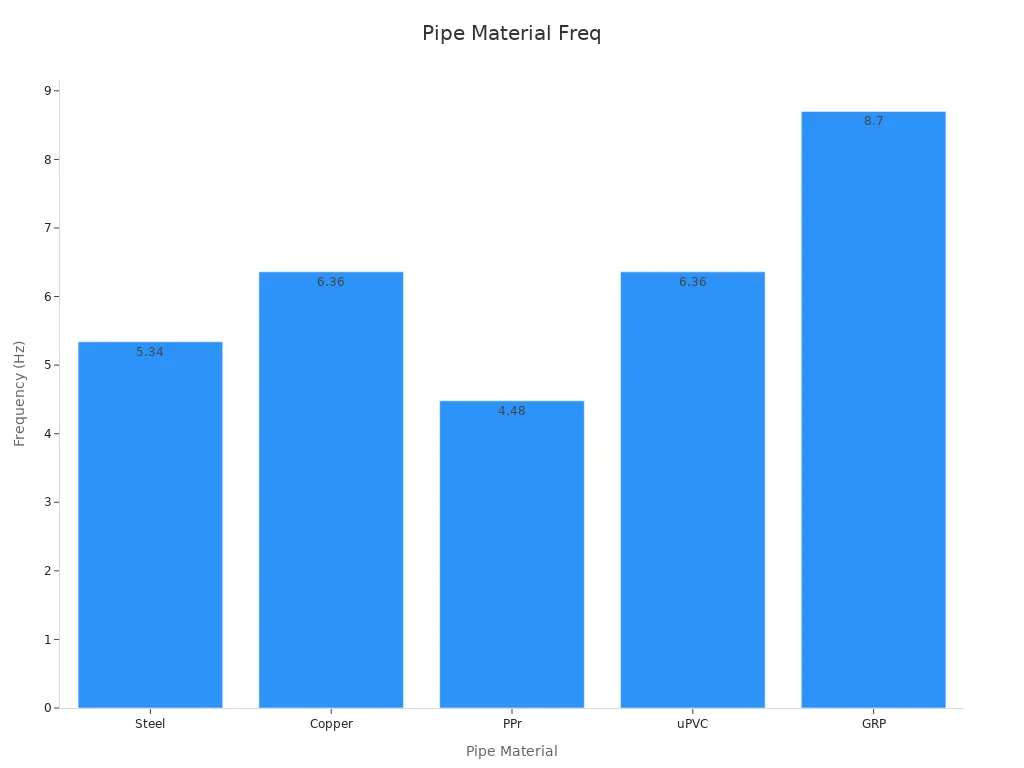
You can see that the pipe’s thickness and material change how it handles pressure and vibration. Always choose the right thickness and diameter for your job.
Understanding Tolerances and Standards
Tolerances tell you how much the actual pipe size can differ from the numbers on the chart. Standards like ASTM A106 and others set these limits for diameter, wall thickness, and length. For example, the outside diameter for NPS 1/8 to 1 1/2 can vary by ±1/64 inch. Wall thickness can be up to 20% thicker or 12.5% thinner than the number on the chart. The length of a cut pipe can be up to 6 mm longer than ordered.
Here is a table with common tolerances:
| Tolerance Type | Specification Details |
|---|---|
| Diámetro exterior (DE) | For NPS 1/8 to 1 1/2: ±1/64 inch; Over 1 1/2 to 4: ±1/32 inch; Over 4 to 8: +1/16 inch / -1/32 inch |
| Espesor de pared | NPS 1/8 to 2 1/2: +20% / -12.5%; NPS 3 to 18 (t/D ≤5%): +22.5% / -12.5%; NPS 3 to 18 (t/D >5%): +15% / -12.5% |
| Longitud | For definite cut lengths: -0 mm / +6 mm |
You should always check these tolerances when you measure your pipe. This helps you make sure the diameter, wall thickness, and length meet your needs and follow the rules.
Applying Dimension Terms in Pipe Selection
Choosing the Right Pipe for Your Project
You need to look at several factors when you select a pipe for your project. Start by checking the pressure, temperature, and environment where you will use the pipe. Different industries, such as construction or power generation, have unique needs. For example, seamless carbon steel pipe works well in high-pressure systems because it has no welded seams. You should also consider the material grade and make sure it matches your strength and corrosion resistance needs.
Here is a table that shows the main points to check:
| Decision-Making Framework Aspect | Description | Performance Metrics / Criteria |
|---|---|---|
| Application Requirements | Check pressure, temperature, and environment | Handles pressure, resists corrosion |
| Industry-Specific Needs | Match pipe type to industry | Welded vs seamless carbon steel pipe, material grade |
| Material and Grade Selection | Choose for strength and durability | Mechanical properties, corrosion resistance |
| Standards Compliance | Follow ASTM, API, and other standards | Meets specifications, passes tests |
| Cost-Benefit Analysis | Balance cost and performance | Cost efficiency, long-term durability |
| Quality Control | Use advanced coatings or materials | Improved strength, longer life |
| Sustainability | Consider recycling and impact | Uses recycled steel, reduces harm |
You should always check the actual length and diameter to make sure the pipe fits your project.
Common Mistakes to Avoid
Many people make mistakes when they choose galvanized steel pipes. One common error is picking the wrong size or material. Galvanized pipes can corrode quickly in wet or urban areas. You might see more failures in places near water or in cities. If you use the wrong pipe in fire protection systems, you could break building codes and risk safety.
- Galvanized pipes often fail in waterbody or sea environments because of corrosion.
- Pipes in urban areas need more checks and maintenance.
- Ignoring water chemistry, like high chlorides or sulfates, can cause white rust and damage the pipe.
- Not following standards or skipping expert advice can lead to leaks or blockages.
Tip: Always match the pipe material and length to the environment and system needs. Check for local rules and consult with experienced installers.
Real-World Examples
Imagine you need a seamless carbon steel pipe for a power plant. You check the pressure and temperature, then pick the right length and wall thickness. You follow ASTM standards and choose a pipe with a strong coating. This pipe lasts longer and needs less repair.
In another case, a builder uses galvanized pipe in a city water system. The pipe fails early because the water has high chloride levels. The builder did not check the water chemistry or the right length for each section. This mistake leads to leaks and costly repairs.
You can avoid these problems by using the correct dimension terms, checking the environment, and following industry standards.
Troubleshooting and Common Misunderstandings
Confusing NPS with Actual Diameter
You may think that Nominal Pipe Size (NPS) matches the actual diameter of a pipe. This is a common mistake. NPS is a standard label, not a real measurement. For example, a 2-inch NPS pipe does not have a 2-inch outside diameter. Instead, it measures 2.375 inches across. The wall thickness changes the inside diameter, but the outside diameter stays the same for each NPS. This system helps engineers and builders use the same fittings, even if the wall thickness is different.
Here is a table that shows how NPS, DN, and actual outside diameter compare:
| DN (mm) | NPS (inches) | Approximate NB (inches) | Actual Outside Diameter (inches) |
|---|---|---|---|
| 30 | 1 1/4 | 1.25 | 1.660 |
| 40 | 1 1/2 | 1.5 | 1.900 |
| 50 | 2 | 2.0 | 2.375 |
| 75 | 3 | 3.0 | 3.500 |
| 100 | 4 | 4.0 | 4.500 |
| 150 | 6 | 6.0 | 6.625 |
| 200 | 8 | 8.0 | 8.625 |
| 250 | 10 | 10.0 | 10.750 |
You can also see the relationship in this chart:
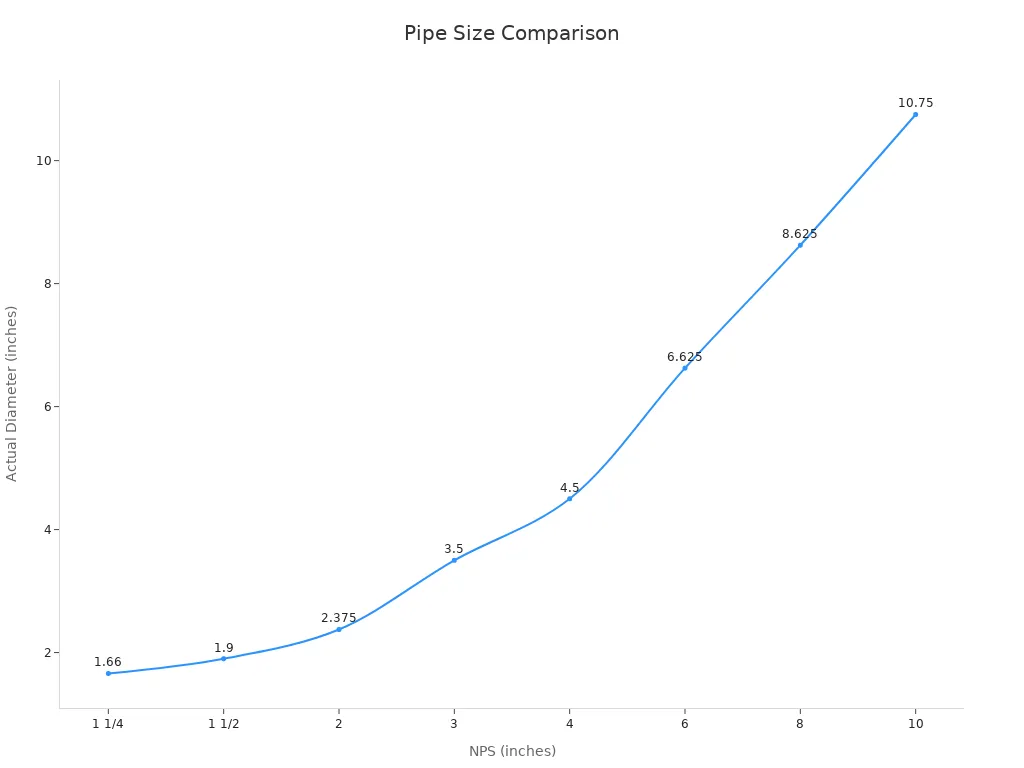
Always check the actual diameter and wall thickness before you order or install a pipe.
Misinterpreting Schedule Numbers
You might see schedule numbers like 40 or 80 and think they show the actual wall thickness. This is not true. The schedule is a code that tells you how thick the pipe wall is, but you need to look up the real thickness in a chart. For example, a schedule 40 pipe and a schedule 80 pipe with the same NPS have the same outside diameter, but the schedule 80 pipe has a thicker wall. This thicker wall means a smaller inside diameter. If you pick the wrong schedule, your pipe may not handle the pressure or flow you need. Always use a chart to find the correct wall thickness for your project.
Issues with Threaded and Coupled Pipes
Threaded and coupled pipes can leak if you do not use the right methods. Many users find that brass nipples work better than dielectric unions when joining copper to galvanized pipes. You should use thread sealants like pipe dope or Teflon tape, but remember, these are lubricants. The real seal comes from the tight fit of the threads. If you skip the sealant, leaks will happen over time. Some people use brass elbows or special fittings for hot water lines to stop leaks. Over-tightening can make leaks worse, so tighten just enough for a good seal. Always use the right materials and sealing techniques for a strong, leak-free connection.
You need to know the key dimension terms for galvanized steel pipes to make smart choices. Industry reports show that accurate pipe sizing helps you meet safety rules and keeps your system strong. When you check these terms, you avoid costly mistakes and meet project needs. Always double-check pipe dimensions before you order or install. This careful approach supports quality, safety, and long-lasting performance in every job.
Remember: Careful measurement and understanding protect your project and your reputation.
Preguntas más frecuentes
What does “schedule” mean for galvanized steel pipes?
Calendario tells you how thick the pipe wall is. A higher schedule number means a thicker wall. You should always check the schedule to make sure your pipe can handle the pressure in your system.
How do you measure the outside diameter (OD) of a pipe?
You use a tape measure or calipers. Place the tool across the pipe’s widest part. Read the number from edge to edge. This gives you the outside diameter.
Why is the nominal pipe size (NPS) different from the actual diameter?
NPS is a label, not a real measurement. The actual outside diameter is often larger than the NPS. Always check both numbers before you buy or install a pipe.
Can you cut galvanized steel pipes to custom lengths?
Yes, you can order custom lengths. Many suppliers offer cutting services. Custom lengths help you fit pipes into special spaces and reduce waste.
What is the best way to prevent leaks in threaded and coupled pipes?
Use thread sealant like Teflon tape or pipe dope. Tighten the threads until snug, but do not over-tighten. Always check for leaks after installation.