

When you select square galvanized steel, you must match the gauge and size to your project’s needs. The right choice supports safety and durability. ASTM A500 standards show that wall thickness and mechanical properties, like tensile and yield strength, help prevent failure. If you pick the wrong gauge, your structure may not hold up. You can avoid costly mistakes by following industry standards and checking the intended load. Square galvanized steel offers strong protection against corrosion and keeps your project stable.
Understanding Gauge and Size in Square Galvanized Steel
What Gauge Means for Square Tube Strength
When you look at square tube specifications, gauge tells you how thick the steel walls are. Thicker walls give your square tube more strength. You need to know that strength helps your project hold weight and resist bending. Tube producers use hardness tests, like the Rockwell B test, to check if the steel tubing meets the right strength. These tests do not measure strength by gauge alone. Instead, they show if the steel tubing can handle the needed load. For the most accurate results, labs use tensile tests. These tests pull the hollow square tube until it breaks. The results show how much force the steel tubing can take before it fails. The table below shows how different sizes and gauges of square tube need different test methods:
| Tube Diameter / Gauge | Specimen Preparation | Tensile Test Method | Strength Quantification |
|---|---|---|---|
| Smaller outer diameter (significantly < 100 mm) | Whole tube used as specimen | Clamped at ends with specimen grips; tube ends compressed | Tensile strength, yield point, strain at break measured per ISO 6892 |
| Larger outer diameter | Longitudinal strip cut from tube wall | Strip clamped with flat or adapted jaw inserts to avoid plastic deformation | Tensile strength, yield point, strain at break measured per ISO 6892 |
How Size Is Measured in Hollow Square Tube
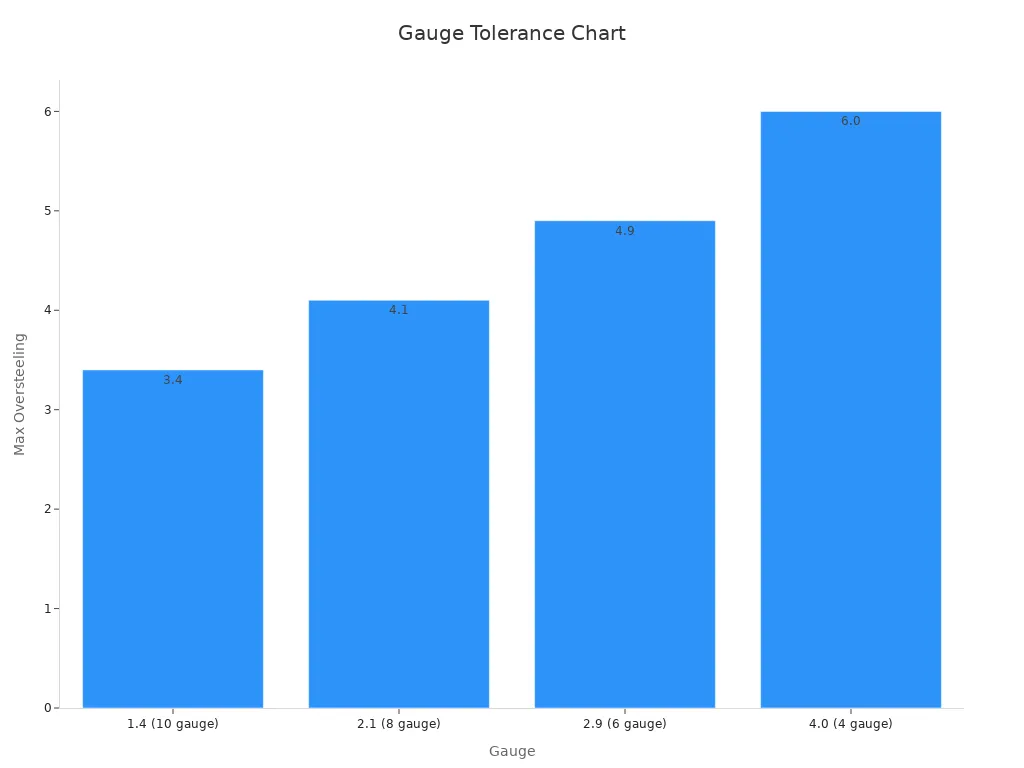
You measure the size of hollow square tube by looking at the outside width and the wall thickness. For example, a 2-inch by 2-inch square tube with a 0.125-inch wall is a common choice for many projects. You must check the size and specifications before you order. The size affects how much weight the hollow square tube can support. You also need to look at the length of the steel tubing. Most square steel tubing comes in standard lengths, but you can cut it to fit your needs. The ASTM A1064/A1064M standard gives you rules for size and gauge tolerances. The chart below shows how gauge and size relate to steel tubing:
Why Gauge and Size Matter for Your Project
You must match the gauge and size of your hollow square tube to your project’s needs. If you pick the wrong square tube specifications, your structure may not be safe. Thicker gauges give you more strength, but they also add weight and cost. If you use a hollow square tube that is too thin, it may bend or break. If you use a tube that is too thick, you may spend more money than you need. Always check the specifications for your square steel tubing. You want your hollow square and rectangular tube to fit your project and last a long time. The right size and specifications help you build strong, safe, and cost-effective structures with galvanized square tube.
Identify Your Project’s Requirements for Square Galvanized Steel
Determining Load and Structural Needs
When you choose for your project, you must first think about how much weight your square tube will need to hold. Load testing shows that steel tubing filled with concrete can carry more weight and bend less. Recent studies use advanced models to predict how much force a hollow square tube can take before it bends or breaks. For example, if you use steel tubing with a yield strength of 50,000 PSI and your project puts 25,000 PSI on it, you have a safety factor of 2. This means your hollow square tube can handle twice the stress before it changes shape. You should always check the load-bearing capacity of your steel tubing to make sure your structure stays safe. Square tube forms are popular because they are easy to work with and help you build a stable building structure. When you plan, think about the longest part of your hollow steel tubing and where the most weight will be. This helps you pick the right supporting material for building structures.
Tip: Always use updated industry standards like ASTM A123 and AASHTO/NSBA S8.3 to check the required specifications for your steel tubing. These standards help you measure coating thickness and make sure your hollow square tube meets safety rules.
Considering Intended Use and Application of Square Tube
You need to match the type of steel tubing to how you will use it. Different application areas of hollow square tubes need different sizes and wall thicknesses. If your project needs to hold heavy loads, pick a square tube with thicker walls and a larger cross-section. This gives your hollow steel tubing more strength and helps it last longer. If you need steel tubing for outdoor use, choose a type with a thicker galvanized coating to stop rust. Think about the environment, too. Wet or chemical areas need special steel tubing to avoid damage.
- For building frames, hollow square tube fits tightly and gives strong support.
- For long spans, square tube bends less than round tubing, so it works better for beams.
- For projects where you need to move fluids, round tubing is better, but for frames and supports, square tube is best.
You should also think about how you will cut and join your hollow steel tubing. Thicker walls may need special tools, but they give you more strength. Always check the standards for your steel tubing to make sure you meet all safety and quality rules before you choose for your project.
Assess Environmental Factors for Your Project
Evaluating Corrosion Risks for Square Galvanized Steel
You need to think about how the environment affects your hollow square tube. Corrosion can damage steel, so you must check the risks before you choose. If you use a hollow square tube in a place with lots of moisture or near the sea, the risk of rust goes up. Pollution in the air can also speed up corrosion. Experts say you should look at local hazard maps and check for things like industrial pollution. These maps help you see where corrosion might happen faster. You should also pick the right steel grade and coating for your hollow square tube. Galvanized coatings give your hollow steel better corrosion resistance. Regular checks and cleaning help keep your hollow square tube strong.
Recent studies show that climate change can make corrosion worse. Higher temperatures and more humidity can shorten the life of your hollow square tube. In some places, steel structures may lose up to 15% of their useful life by the end of the century. This means you need to plan for more maintenance and maybe choose a thicker coating for better corrosion resistance. If you want your hollow square tube to last, always match the coating and steel type to your local weather and pollution levels.
Indoor vs. Outdoor Use of Hollow Square Tube
You must decide if your hollow square tube will stay inside or outside. Indoor use gives your hollow steel more protection from rain and chemicals. This means you can focus more on strength and less on corrosion resistance. Outdoor use brings more risks. Sun, rain, and pollution can all hurt your hollow square tube. You need to pick a tube with strong corrosion resistance for outdoor projects. A thicker galvanized layer helps your hollow square tube last longer outside.
Tip: For outdoor projects, always check the local weather and pollution. Choose a hollow square tube with extra corrosion resistance for the best durability.
If you use your hollow square tube in a wet or salty place, you need to check it more often. Regular care keeps your hollow steel strong and safe. By thinking about where you use your hollow square tube, you make sure your project stays safe and lasts a long time.
How to Choose the Right Gauge and Size of Square Tube
Matching Gauge to Strength and Safety Needs
You need to match the gauge of your square tube to the strength and safety needs of your project. Gauge tells you how thick the walls of your square steel tubing are. Thicker walls give you more strength and help your structure resist bending or breaking. If you want high strength and rigidity, you should choose a lower gauge number, which means thicker steel tubing.
Structural engineering research shows that the right gauge can double the compressive strength and ductility of square tube columns. For example, corrugated square steel tubing can improve compressive strength up to two times compared to flat plates. The width of the internal corrugation also matters. A width of 116 mm gives 25.3% higher strength than a 160 mm width and 7.4% higher than a 60 mm width. These findings help you choose the right square tube for your project.
| Parameter/Aspect | Key Findings |
|---|---|
| Corrugated vs Flat Plates | Corrugated tubes improve compressive strength and ductility up to 2x |
| Internal Corrugation Width | 116 mm width yields 25.3% higher strength than 160 mm, 7.4% higher than 60 mm |
| Outer Corrugation | Reduces compressive strength, but lowers weight for high hollow ratios |
| Concrete Strength | Main factor for ultimate strength of columns |
| Section Hollow Ratio | Higher ratio increases ductility and affects strength |
You should always check the square tube specifications before you buy. If you use square galvanized steel in a place with high wind or heavy loads, you need a thicker gauge. For example, in ‘Project Alpha,’ engineers used 18-gauge square steel tubing for roof trusses. This choice reduced steel tonnage by 22% and still withstood 140 mph wind loads. You can see how the right gauge keeps your project safe and cost-effective.
Tip: Always use updated standards and test data to confirm the strength of your square galvanized steel. This helps you avoid underestimating the load your structure will face.
Selecting Dimensions for Fit and Function in Your Project
You must select the right dimensions for your square tube to make sure it fits your project and works as planned. The size of your square steel tubing includes the outside width, wall thickness, and length. Each part affects how much weight your structure can hold and how easy it is to assemble.
When you choose the right square tube, think about the fit and function. For frames, you want square tube specifications that match the load and the space you have. If you need to span a long distance, pick a larger size for more strength. If you need to fit the tube into a tight space, measure carefully and check the specifications.
Research shows that the section hollow ratio and width-to-thickness ratio affect the strength and stability of square steel tubing. A width-to-thickness ratio between 6 and 35 has little effect on compression stability, so you have flexibility in choosing the right size. Material properties like yield strength and elastic modulus matter most when the slenderness ratio is between 20 and 80. You should also consider the quality of the steel tubing. High-quality square galvanized steel gives you better durability and performance.
- Use a tape measure to check the outside width and wall thickness.
- Compare your measurements to the square tube specifications from the supplier.
- Make sure the length matches your project needs.
- Choose the right size for both strength and fit.
Note: If you need high strength, select a larger size and thicker gauge. For lighter loads, you can use a smaller size to save on cost and weight.
Common Mistakes to Avoid When Choosing Square Galvanized Steel
You can avoid many problems by watching out for common mistakes when you choose the right square tube. Many people pick the wrong gauge or size because they do not check the specifications or the quality of the steel tubing. This can lead to weak structures, wasted money, or even safety risks.
Here are some mistakes to avoid:
- Ignoring the load requirements for your project.
- Choosing a gauge that is too thin for the expected strength.
- Not checking the quality of the square galvanized steel.
- Overlooking the importance of durability in harsh environments.
- Failing to match the size to the fit and function of your project.
- Not reviewing the square tube specifications before ordering.
- Forgetting to check for updated standards and certifications.
Case studies show that using the right gauge and size can lower costs and improve safety. For example, a coastal shading system retrofit used hollow-profile tubes with defined density and recycled content. This project achieved a 41% lower lifecycle cost and met all strength and safety needs. In another case, automotive assembly lines used square steel tubing frames to improve assembly time by 31% and reduce labor costs.
Always double-check your measurements and specifications. High-quality square galvanized steel and the right size help you build strong, safe, and long-lasting structures.
Quality Standards, Certifications, and Cost Considerations
Checking Industry Standards for Square Galvanized Steel
You need to check quality before you buy square galvanized steel. Industry standards help you know if the steel meets the right level of quality. Look for certifications like ASTM A500 or ASTM A123. These show that the steel has passed tests for strength, coating, and durability. You can ask your supplier for test reports or certificates. These documents prove the steel meets the required quality.
When you check quality, look for these signs:
- The steel has a smooth, even galvanized coating.
- The tube has no dents, cracks, or rust.
- The supplier gives you clear information about size and gauge.
- The steel comes with a certificate or test report.
Tip: Always ask for proof of certification. This helps you avoid low-quality steel that may not last.
Balancing Cost, Performance, and Longevity in Your Project
You want to get the best value for your project. You must balance cost, performance, and how long the steel will last. High-quality square galvanized steel may cost more at first, but it can save you money over time. Good quality steel resists rust and damage. This means you spend less on repairs and replacements.
Here is a simple table to help you compare options:
| Option | Upfront Cost | Performance | Longevity |
|---|---|---|---|
| Low-quality steel | Low | Poor | Short |
| Standard-quality steel | Medium | Good | Medium |
| High-quality steel | High | Excellent | Long-lasting |
If you pick low-quality steel to save on cost, you may face problems later. You might need to replace parts sooner or fix damage. When you choose high-quality steel, you protect your project and lower long-term costs.
Note: Always think about the total cost, not just the price you pay at the start. Quality steel gives you better results and peace of mind.
Quick Reference Table: Square Galvanized Steel Gauge, Size, and Typical Uses
When you choose square galvanized steel, you want to make the right decision fast. This quick reference table helps you match the gauge and size to your project. You can use it to find the best option for your needs.
| Gauge (Wall Thickness) | Common Size (inches) | Typical Use Case | Example Projects |
|---|---|---|---|
| 22 (0.025″) | 1 x 1 | Light-duty, indoor | Display racks, crafts |
| 18 (0.049″) | 1 x 1, 1.5 x 1.5 | Medium-duty, indoor/outdoor | Furniture frames, fencing |
| 16 (0.065″) | 2 x 2, 1.5 x 1.5 | General structural, outdoor | Railings, small gates |
| 14 (0.083″) | 2 x 2, 2.5 x 2.5 | Heavy-duty, load-bearing | Deck supports, sign posts |
| 11 (0.120″) | 3 x 3, 4 x 4 | Extra heavy-duty, high load | Building columns, carports |
Tip:
Always check your project’s load and environment before you pick a gauge. Thicker walls give you more strength and last longer outside.
You can use lighter gauges for indoor projects that do not need to hold much weight. For outdoor or heavy-duty jobs, pick a thicker gauge and a larger size. This helps your structure stay safe and strong.
- Use this table as a starting point.
- Measure your space and check your load needs.
- Ask your supplier if you need a custom size.
If you follow this guide, you will find the right square galvanized steel for your project. You save time and avoid costly mistakes.
Practical Tips for Choosing Hollow Square Tube
Tips for Accurate Measurement and Ordering
You want your project to fit together perfectly. Accurate measurement and ordering help you avoid waste and mistakes. Start by using a reliable tape measure or caliper to check the outside width and wall thickness of each hollow square tube. Always measure twice before you order. Write down your numbers clearly.
Many factories now use optical measurement systems like TUBEINSPECT. These tools use light to check the size and shape of each hollow tube. They do not touch the metal, so they do not cause dents or bends. You get fast results and can fix problems right away. These systems also work with CNC machines to make sure every hollow square tube matches your design.
Best practice guides suggest you:
- Choose hollow square tube sizes based on how much weight they must hold.
- Check that each tube meets standards like ASTM or EN.
- Inspect welds and seams for cracks or rough spots.
- Look for a smooth, even surface on every hollow tube.
- Order a few extra pieces in case you need replacements.
Tip: Train your team to use measurement tools and follow a checklist. This helps you catch mistakes early.
Avoiding Common Pitfalls with Square Tube Selection
You can avoid many problems by watching for common mistakes. Some people pick the wrong hollow square tube because they skip important steps. Do not rush your choice.
Here are some pitfalls to avoid:
- Ignoring the load needs of your project. Always match the hollow square tube to the weight it must support.
- Forgetting to check for rust or damage on the surface.
- Ordering the wrong size or length. Double-check your list before you buy.
- Choosing tubes that do not meet quality standards. Look for certifications from trusted groups.
- Picking a hollow tube with poor welds or seams. Weak spots can cause failure.
Note: Never let cost be your only guide. Low-quality hollow square tube may save money at first, but it can lead to bigger problems later.
If you follow these tips, you will get strong, safe, and long-lasting results for your project.
Choosing the right square galvanized steel helps you build safe and long-lasting projects. You should always match the gauge and size to your needs and the environment. For example:
- A60 coating gives better corrosion resistance for outdoor use, while A40 works well indoors.
- Picking the right coating and size can lower maintenance costs and extend lifespan.
| Industry | Gauge Range Used | Purpose / Reasoning |
|---|---|---|
| Automotive Manufacturing | 10-14, 20-24 | Frames need strength; panels need less weight. |
| Konstruktion | 14-18, 26 | Framing and roofing require durability and strength. |
If you feel unsure, talk to a professional. This step keeps your project safe and cost-effective.
FAQ
What does “gauge” mean in square galvanized steel?
Gauge tells you how thick the steel walls are. A lower gauge number means thicker steel. Thicker steel gives you more strength and helps your project last longer.
How do I measure the size of a square tube?
You measure the outside width and the wall thickness. Use a tape measure or caliper for accuracy. Always check both numbers before you order your steel tubes.
Can I use the same gauge for indoor and outdoor projects?
No, you should not. Outdoor projects need thicker gauges and better coatings to resist rust. Indoor projects can use thinner gauges because they face less moisture and fewer harsh conditions.
What happens if I pick the wrong size or gauge?
If you choose the wrong size or gauge, your structure may bend, break, or rust faster. You might spend more money fixing problems. Always match the steel to your project’s needs.